

14 Jan LiMPETS Students Present Their Research
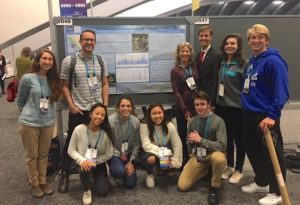 High school students from the Branson School participating in the Greater Farallones LiMPETS program shared their research among scientists at the American Geophysical Union (AGU) Conference in San Francisco on December 12, 2019. The “Sustainable Seas Student Monitoring Project” examined student-collected data from 2005-2019 at Duxbury Reef State Marine Conservation Area in Bolinas, CA. Students noticed a 49% increase in Turban snail abundances and a decrease in iridescent algae, a food source for turban snails, coinciding with the unprecedented El Niño in 2015-2016. Students proposed that resulting storms from the El Niño, and the loss of turban snail predators such as ocher stars to Sea Star Wasting Disease along the coast, as possible explanations in need of further study.
LiMPETS (Long-term Monitoring Program and Experiential Training for Students) Network reaches over 6,000 students annually statewide, exposing them to California’s sanctuaries and engaging them as ocean stewards. By presenting at this scientific conference, LiMPETS students learn how to summarize scientific results and gain scientific communication skills in a real-world setting.
Learn more about the Greater Farallones LiMPETS Program.
Project abstract:
The Sustainable Seas Student Monitoring Project at the Branson School in Ross, CA has monitored Duxbury Reef in Bolinas, CA since 2000, in cooperation with the Farallones Marine Sanctuary Association and the Gulf of Farallones National Marine Sanctuary. Goals of this student-run project include: 1) To monitor the rocky intertidal habitat and develop a baseline database of invertebrates and algal density and abundance; 2) To contribute to the conservation of the rocky intertidal habitat through education of students and visitors about intertidal species; 3) To increase stewardship in the Gulf of the Farallones National Marine Sanctuary; and 4) To contribute abundance and population data on key algae and invertebrate species to the national database, LiMPETS (Long Term Monitoring Program & Experiential Training for Students). Students, trained each fall, identify and count key invertebrate and algae species along two permanent transects and, using randomly determined points, within two permanent 200 m2 areas, in fall, winter, and late spring. Using data from the previous years, we will compare population densities, seasonal abundance and long-term population trends of key algal and invertebrate species, including turban snails, Tegula funebralis, and iridescent algae, Mazzaella splendens. Future analyses and investigations may include population counts for the pisaster sea star, Pisaster ochraceus, and intertidal abiotic factors (including water temperature, pH and human foot-traffic) to enhance insights into the Duxbury Reef ecosystem, in particular, the high and mid-intertidal zones experiencing the greatest amount of human impacts.
View on the American Geophysical Union (AGU) Conference website.
Sorry, the comment form is closed at this time.